Friday, May 31, 2013

MAY - The Painted Girls

May review for the Eclectic Reader's Book Challenge 2013: The Painted Girls by Cathy Marie Buchanan, 2013. [Published in 2013 category]

At its simplest, The Painted Girls by Cathy Marie Buchanan is an inventive historical novel about a young girl who modeled for Edgar Degas. The text expands on the story of the young Marie van Goethem, beginning in 1878 Paris shortly after her father has died suddenly, leaving them under the wobbly care of their absinthe-soaked washerwoman mother. Marie and her two sisters, Charlotte (younger) and Antoinette (older), have to find their way through the poverty-riddled slums on their own, using only their smarts and their dancing shoes to climb their way up. However, beneath the surface it is much more than that. Set in the Belle Époque of Paris during the years of Edgar Degas’s rise to fame and Emile Zola's stage blowout, The Painted Girls follows the real-life model for Degas's wax-and-fabric sculpture Little Dancer Aged Fourteen as she and her sisters create a tenuous touchstone to the rest of the era. It clear-headedly examines the little-known seedy side of Paris that exists behind the shining tutus of the petit rats of the Paris Opéra and the life a young girl must lead to try to pull herself out of it.

Using three historical events from the 1880s as the framework for her novel, Buchanan takes these events and embellishes her two protagonists lives to create spider-thin connections between them, yet somehow they feel organic, though they are "little more than imagination and ink" (Author's Note, 353). Each historical prong has been thoroughly researched and documented in the novel, providing actual newspaper clippings in addition to some of her own imagination, and each element seems designated to a particular sister or their relationship to one another. Historical fiction such as this has always intrigued me, watching an author ask herself questions to delve into a part of a historical world, wondering what questions those characters asked themselves to move through their lives. Degas and his paintings are the realm of middle child Marie, trying to succeed in the Opéra where her elder sister failed, perhaps taking the path that Antoinette would not, with her sharp tongue and lack of filter. L'Assommoir by Emile Zola is Antoinette's domain; It is where she discovers a different sort of performance life, as well as the darker parts of the world. It is where she meets the man who is to bring her into womanhood and farther away from her little sisters. And finally, the famous criminal trial of Émile Abadie and Michael Knobloch. By making Abadie the lover of Antoinette, this trial deepens the rift between Antoinette and Marie, each trying to keep the family afload, yet not understanding how the other means to do so. The connection comes full circle with Edgar Degas's studies of the two criminals at their trial, as seen below.


Degas's Criminal Physiognomies, from the trial of Émile Abadie and Michael Knobloch, ca. 1880-81.

One of my favorite things about this particular book was the existence of real-life objects that correlated to Buchanan's striking prose. (A shortcut to all the paintings mentioned in the book accompanied by their quotes can be found on the author's site here). I have long been in love with the brushstrokes of Edgar Degas, and my small, square book of Degas paintings helped me enjoy this novel so much more. Having such a tangible connection to the past allowed Buchanan the ability to focus not so much on the paintings themselves--because they existed, and readers could check them out in reference for themselves--but more on what the paintings meant in this insular little world she was creating, allowing her to go deeper into the characters and their motivations, all the while leading us by the hand beneath the strokes.

Another seemingly small point of reference is Buchanan's seamless inclusion of untranslated ballet terms. She threw around petit rat and ronds de jambe as if they were nothing, and although it would've been nice to have a glossary on hand for the uncultured observer, at the same time it almost added to the completeness of the Paris world by its omission. These girls know the words that will get them out of the slums and into the Opéra, they know the body positions that they translate to, and the words are simply part of the atmosphere.


The famed statue, Little Dancer Aged Fourteen.

Part of the beauty of Buchanan's newest novel is that it isn't about the pretty people, the lifestyles of Paris, so to speak. It is about the hardened ones. The girls who try and try and fall down again and again, to the point where sometimes it seems, like Marie says in her interpretation of Zola's play, "it is about being born downtrodden and staying that way. Hard work makes no difference" (98). As Marie's story goes on, she begins to identify more and more with that sentiment, against her will, as she tries to make the right decisions but keeps getting stuck with the wrong ones. Buchanan allows us inside Marie's head for shorter stretches of time as the novel reaches its climax, the shorter structure seemingly mimicking the young girl's downward spiral. "A life, unfolding the only way it can," it is said of L'Assomoir throughout the text, and the reader wants to fight for Marie as much as she can to make sure Marie gets what she wants in the end (99).

Published in early 2013, The Painted Girls marks only the second novel under author Buchanan's belt, and already she is quickly becoming regarded as a new force to be reckoned with.

Friday, May 24, 2013

Clayton Family Israel Trip 2013!

Hello blogosphere! 
My parents and I are on our way to Israel to see my baby brother! Sitting in the airport, trying to get on the "free" wifi (such problems, I know), we're all getting super excited! I haven't been to Israel in 5 years, haven't seen my brother in 5 months, and I cannot wait for them both to happen again so soon. Mom and Dad have never been to Israel, and I'm looking forward to showing them the country nick and I have fallen in love with. Going to board soon, I will write again when the opportunity presents itself! 

Friday, May 10, 2013

Nothing Brave about it

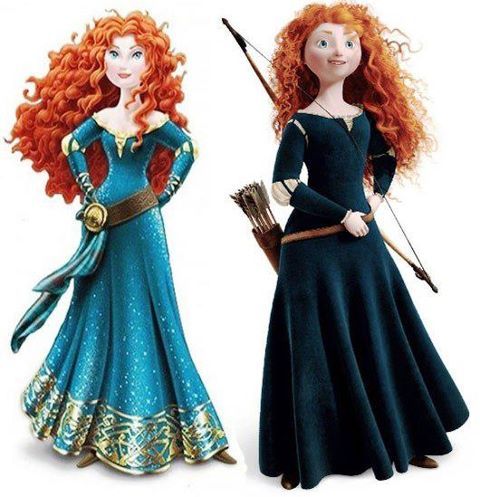
Brave's Merida will join the Disney Princess Hall of Fame tomorrow (May 11) but before her big day, she's going to get a little "sprucing up." And it makes me absolutely livid.

When I saw Brave (Pixar, 2012) this past summer, I was thrilled. Finally Pixar had a female protagonist, a strong one who got the name of the film as her callsign, who was part of the front lines of battle, not the front lines of the welcome home party. She is an archer, my #1 fantasy skill, which made me even more predisposed to it. According to UnrealityMag, "It’s an anti-princess tale of sorts, and the grand pursuit is not of the affection of a boy, but rather reconciliation between a mother and daughter. Not a bad play for Pixar’s first female-led feature."

Merida is the most un-princessy princess to join the cadre of animated stars, and I loved her for it. Even if it didn't push as hard against the traditional paradigm as other Pixar features historically have, it was still a beautifully brought to life step in the right direction. (Merida's hair. Case in animation point.) But now there is this. This unnecessary bastardization of everything Merida represents is appalling. Thinner waist, smoother hair, bigger eyes--all traits that make her more vulnerable, more fragile. Everything Merida pushes so hard against. When the movie first came out, a Huffington Post blogger, Kristen Howerton, wrote that Brave could be considered the "first feminist princess movie," but this "redesign" pretty much whitewashes that whole message. It was never about being brave, it was always about being pretty. It is exactly this kind of thinking that made Merida so angry when her parents tried to force the whole marriage-by-circus-contest thing. If anything, it should be the other way around. The other "princesses" have a thing or two to learn from Merida. (Except for Alice. Alice could pretty much take care of herself.) And even though Merida only has the voice she was written with, we can add our voice to people like Kristen Howerton's and A Mighty Girl's and say HELL NO to this dumb revamp. So please for god's sake, sign A Mighty Girl's petition on MoveOn.org. Keep us moving forward. A princess can be a feminist.

Source: Merida From 'Brave' Gets An Unnecessary Makeover, Sparks Change.org Petition (PHOTO)

Tuesday, April 30, 2013

That Vitamin C Song (#30/30)

[Prompt for today: "30. That's All Folks: Write a poem where something (big or small) comes to an end." this is particularly fitting because I am going to be graduating this weekend and I wanted to write about how i'm feeling in the days before.] Blogging has taught me to let go of my perfectionism. These months of self-directed writing no deadlines save the ones i suggest to myself have taught me to just get it out finish it up write what you feel not what you think Graduation has taught me to let go when I thought I already had. Walking through the Diag to get tickets for commencement for the Big House for the end and there is a surprising lump in my throat I thought I was done thought I was ok but watching students walk my walk from months ago thinking i'll never walk that again not the same way and it scares me, this ending i'm afraid that i won't know how to begin again

APR - John Dies At The End

April review for the Eclectic Reader's Book Challenge 2013: John Dies At The End by David Wong, 2009. [Urban Fantasy category]

This book is difficult to review without giving everything away. It is not a typical book where I can start at the beginning and muddle through the middle but stop before giving away the ending: the title alone makes that impossible. A rising cult classic for sure, John Dies at the End by David Wong is a beast of its own class. David, both the protagonist and a pseudonym for Jason Pargin, senior editor at Cracked.com, invites us into a horror-comedy about two twenty-something fuck-ups who somehow stumble their way into being a sort of Ghostbuster/Clerks/Supernatural type of mash-up. A friend had suggested the book to me and made me watch the Coscarelli film (2011), which I thoroughly enjoyed, and since this friend doesn't read too much but raved about this particular volume, I decided to give it a shot. I'm not sure exactly what I expected going in, but it certainly wasn't that.

Needless to say, I heartily enjoyed it. The characters, while neither particularly heroic or even likable in the traditional sense of the word, are real, their thoughts raw and unpolished coming directly from David's internal POV. The storyline(s) are so far-fetched yet intriguing that we as readers desperately want to believe in them. The major thrust is that of a wrathful alien invasion of which most of the populace is unaware, but the book is broken up temporally by a frame story, one that involves Dave and a bumbling reporter meeting at a back-alley Chinese restaurant for Dave to convince said reporter of his story--and subsequently, his (relative) sanity. The reporter, Arnie Blondestone, acts on behalf of the reader, calling Dave on his inconsistencies and asking the very obvious questions, all the while sitting back in a state of half disbelief, half intrigue. Some reviewers have pointed to the books original status as web serials that might allow for the contradictions, and while I see that is a valid point, I also like to think that it's something Dave has woven in of his own accord. This is a book trying to show "actual, soul-sucking lunacy," as one reviewer said, and the mind of the lunatic we get is rife with the unimaginable; it is only logical that his brain might fail in the description of it.

That being said, some parts of the story are actually acknowledged as possibly ill-reported, mostly because they come secondhand from John, the other half of this monster-fighting duo. Though John claims the title and most of the spotlight, his story is still told through Dave's intimacy with the reader, his raw point of view. Dave sees himself as a sort of shadow of John, but in that humility lies an honesty that is both endearing and grounded, and while neither of the characters is particularly heroic or even likable in the traditional sense of the word, as David is quick to point out--but then, nothing about this book makes sense in the traditional sense of the word.

In any elaborate created world, there is always a "set piece," a sort of touchstone that defines the rules of the universe: the One Ring in Lord of the Rings, the TARDIS in Doctor Who, In this case, it is the Soy Sauce. It is almost sentient, and it seems to be an adequate metaphor for the story itself. Wong started publishing his story that would become John Dies serially online where it took on a cult force of its own and has eventually made it into the hands of horror-comedy filmmaker genius Dan Coscarelli, the mind responsible for works like Bubba Ho-Tep (2002)--you know, the one about Elvis in a senior home fighting demons. A certain brand of crazy has taken seed in this genre, a hyperabsurdity that breathes itself into every aspect of the story and makes it somehow more real, like Amy's phantom hand syndrome that can open the ghost door because neither of them is actually there.

The ghost door(s) is a good example of how John Dies fits under the umbrella of Urban Fantasy. Some parts of the internet define urban fantasy as "sub-genre of fantasy defined by its place...a prerequisite is it must take place in a city." The world of the boys' hometown, Undisclosed, is just enough like the reader's reality to make us comfortable, but with minor differences like the ghost doors and talking bratwursts. Also the fact that the differences are unseen by many--like typical fantasy--contributes more to the hyperabsurdity of the whole deal and the outsider's view of David's crumpling sanity. Because Dave keeps so much under his hat, changing things or only saying them in his head--like calling his hometown "Undisclosed" so much that it becomes a place in and of itself--he gives a power not only to his own world but to the world he is laying out for Arnie Blondestone. The "undisclosed" nature of Undisclosed. how it sort of circumvents the typical definition of "urban fantasy" by circumventing the typical definition of "city," and like many aspects of this book, therefore becomes more tantalizing.

I am severely looking forward to reading the sequel and keeping up with David Wong's future endeavors. The man is funny, and he makes me laugh in a way that I haven't experienced in a long time. Like this article on Cracked that includes not one, but two tongue-in-cheek, quasi-hysterical reviews of his very own book. But somehow, it doesn't make him seem like a huge tool.

some of my favorite (and more colorful) blurbs about John Dies At The End:

"John Dies at the End...[is] a case of the author trying to depict actual, soul-sucking lunacy, and succeeding with flying colors." --Fangoria

"Reads as if Bill Murray's world-weary Ghosbuster and sassy Buffy the Vampire Slayer spawned a slacker child--like Clerks with monsters. . . . Surprising, disturbing, and inventive." --Herald Sun (Australia)

other reviews I enjoyed:
"The Designer's Drugs" at Second Supper

Monday, April 29, 2013

Tweet tweet (#29/30)

[prompt was to write a poem in less than 140 characters, as if it were on twitter]

A bar is a strange place in the daytime.
The outside world invades with the 2pm sunbeams,
stabbing into your bubble,
not letting you forget.

Sunday, April 28, 2013

Asparagus (#28/30)

[I made asparagus today for the first time in years, and it reminded me of this moment when my best friend and i were kids and her mom told us the secret to asparagus]

Sunday afternoon asparagus experiment

long green stalks with pinecone heads
on my plate
send me back.
me and maddie, the girl around the corner
best friends since birth
eating lunch with her mother,
purveyor of fart jokes and bodily wisdom
from all her years as a floater nurse.
we wouldn't touch the green stringy things
no way, they looked gross, no
we wanted candy.
not until she told us
The Secret.

"The funny thing about asparagus," Julia said,
"is that if you eat enough of it,
you pee green!"
She giggled as we turned to each other
eyes wide as our still-full plates
sucking in a breath for a beat before
diving into the icky greens before us,
all thoughts of sugary goodness banished
and in our infinite wisdom and knowledge
of the human digestive system,
we ran straight to the bathrooms
once we greedily slurped down our last conquered string
to watch the magic happen

after a few minutes,
we met back in the living room,
frowns as droopy as the twizzlers we'd been tricked out of eating
Julia laughed from her perch on the kitchen counter and told us
like any good magic,
this one comes
with waiting.