Monday, April 1, 2019
DEC - The Chilling Adventures of Sabrina
Netflix adapted Chilling Adventures of Sabrina last year and I, like many horror fantasy fans, was rightly excited. Kiernan Shipka looked perfect, and I couldn't wait to see Miranda Otto in a new light. Needless to say, I greedily binged the series when it came out and went out in search of the original graphic novel, to really round out my obsession.
The graphic novel is certainly much darker than the Netflix adaptation, killing Harvey instead of his brother, and playing into the trauma surrounding Sabrina's father more deeply with (~spoilers~) his spirit coming back in Harvey's body. I think I liked what the adaptation did, shifting the darkness in certain ways, such as those mentioned above, to make the horror hit a little more closer to home, not as on-the-nose.
One thing I really liked about the graphic novel was the Riverdale crossover: we actually got to see characters from the Riverdale universe come into Sabrina's world (much to their dismay, however), and I look forward to seeing whether that will come into play in the adaptation as well, seeing as the Riverdale TV show is so very popular already.
Reading this copy of Chilling Adventures: Vol I, there was an introduction by Roberto Aguirre-Sacasa, talking about his process, how he came to the story and how he found the right feel. I absolutely feel like the art style was positively reflected in the Netflix adaptation, and I found it perfectly on-key for the vibe of the story. I look forward to moving further into Sabrina's world, both reading and streaming.
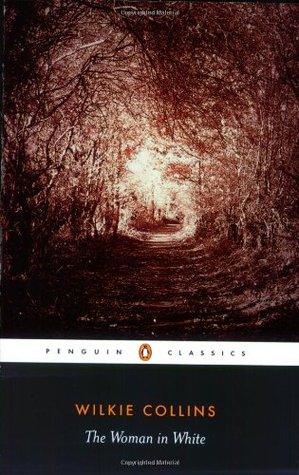
DEC - The Woman In White
I really, really wanted to like The Woman In White by Wilkie Collins. It's the OG gothic horror novel, called the first "sensation fiction" and one of the first mystery novels, and there were parts of it that were really good! The mystery was fun (one of the reasons I actually finished it) but there were just some needling things that I could not get over. This was my December 2018 book, but I just needed such long cooling-off periods in between reads that it stretched over into the new year. (As did the penning of this blog post....) But here we go. The Woman In White starts with "an eerie encounter on a moonlit road," according to all the summaries of it, but I'm going to be honest and say I just didn't find it quite that eerie. Maybe because I am distanced from the time in which it was written? But I digress. Walter Hartwright meets a woman on a road late at night, she tells him a story, and disappears into the darkness (despite wearing the brightest white the guy has ever seen). Then he hears a rumor she might've escaped from an asylum. My knee-jerk reaction is to always sympathize with women who claim unlawful incarceration, especially in asylums, especially with the imbalance of power that comes from taking away a human's agency and the stability of their mind. So I was already on this woman's side, and not Mr. Hartwright's, so I might not have been Mr. Collins's intended audience. I was forging my own path. Marian of course catches her death while she eavesdrops and is PRETTY MUCH INCAPACITATED FOR A GOOD PORTION OF THE REST OF THE BOOK, allowing the next step of the shitty men's plan to come to fruition. AWESOME. But it's not like she could've done much, anyway, remember? She's just a woman.
The anger continued as I stubbornly made my way through the rest of the book. The twist was relatively interesting, and something that I only partially saw coming (the gist of it, not the particulars), and so I soldiered on.
Stayed home sick from work today in this #polarvortex. Thought I would power through #WomanInWhite but it's just making me ANGERY #ragereading #currentlyreading pic.twitter.com/TZjuUSZvn4— Caitlin Sonnet Boom Clayton (@SonnetWrites) January 31, 2019
The book is sort of an epistolary fiction, taking sections from each player and point of view, their diaries and correspondence, so it was interesting to move through different "versions" of the story, especially at the end when so much comes to a head and things are revealed. I can't really summarize the end because I am too tired for it and also no spoilers, but needless to say shit goes down, women get some measure of power, but ultimately it is the men who "fix" everything. Because of course. I would have liked this book more if the power the women got was sustained and appreciated. If Marian had actually used her strength to get her sister out after she, too, was wrongfully shut up in an asylum, instead of the men "allowing" her to do it behind the scenes. The suggestion that every move a woman made was foreseen and encouraged by the men around them was just infuriating, and the systematic denial of the women characters any sort of thought or even self-appreciation was just exhausting. I don't know if Wilkie Collins hated women or had complicated feelings about them and was just toeing the party line of the late 19th century, but the fact that this was a highly original type of story is diminished in my eyes by his treatment of these characters. In fact, the entire premise of the mystery depends on the subjugation and other-ness of the women involved, so really, this story could not have been told if he felt any differently about women.
Reader, I finished it. I suppose I am glad to have read it (something I always gauge myself on when I finish something I don't love), and I am glad to have had the outlet of Twitter and my friends to keep me sane through the reading of it.
Monday, March 25, 2019
OCT - Handling The Undead

Handling The Undead by John Ajvide Lindqvist is a spooky book. But spooky in the way that it's pretty much our normal, everyday world, except for this one supernatural turn. I recognize that a lot of horror (and also thriller) can be explained this way, but my point is that Lindqvist doesn't come at the novel from the perspective of writing a scary story. He introduces human emotion and watches what happens when the world is turned upside down. What does grief do to a person, especially in the face of the impossible?
When the city is faced with a heat wave and weird occurrences start bringing people's loved ones back to life...but are they the same people? David's wife is the first one to come back, and he always knew she was too good for him, so how is he supposed to carry on and raise their kid without her? Or how can a grandfather go on without his favorite grandson? Or an old woman whose husband died recently, and his recurrence makes her question everything about her faith? Slowly, the country figures out what to do with the risen dead, calling in the army to sequester the increasingly more violent problem, and people pack in to see their loved ones when everything goes terribly wrong. Again, Lindqvist manages to tap into the most human part of horror, and Handling The Undead will leave you with the slightest of tingles at the base of your scalp long after you've turned the last page.
Friday, June 15, 2018
APR - Monstress Vol. 1: Awakening

Monstress Vol 1: Awakening is so incredibly visual. Every panel was so intricate that I spent extra time just looking at the pages after I'd finished reading them. Monstress is set in an alternate matriarchal 1900s Asia, a world that seems as dark and twisty and intricate as the illustrations that bring it to life.
I'm into rebellion stories lately, it seems. From the first, our main character is fighting. She is haughty when she has no reason to be, she bristles at her situation though she seems almost detached from it. She enters the story naked, on display and up for auction, but her narration is the first thing to read. Even then, things seem to be on her terms. We don't even get her name right away. That was one thing I really liked about Monstress Vol I was the fact that it didn't lay out everything at the start. In medias res, for serious... We are dropped in along Maika's quest, and little bits are only revealed through flashbacks or conversation, or the occasional "lecture" between parts by animal professors. It kept me reading, to try to put all the pieces together.
Tuesday, March 10, 2015
FEB - Let The Right One In
This month's category is "set in a country starting with S," appearing easy enough, and right off the bat I probably would've picked Spain because I'm obsessed with Spain, but I picked this book up shortly after seeing the film and it's been on my vampire shelf (yes, I have a section of a shelf for vampire stuff, and no Twilight is not on it) taunting me. And conveniently, the fact that it was set in Sweden caused this book to be a perfect fit for this month. I haven't read many books about Sweden, save the Stieg Larsson books, and I thoroughly enjoyed venturing into a country I didn't know much about. The streets and towns and shorthands were unknown to me, allowing me to immerse myself a little more fully in the story. The prologue began after the events of the story took place, and they whisked you back effectively enough to merit the hungry turning of every page.
The book is divided up in days, stretching from October 21 to November 13, detailing events taking place in Blackeberg, a suburb of Stockholm, in Sweden. The point of view is omniscient, moving from different characters, their stories slowly seeping together over the course of nearly a month of interactions in a small town. Lindqvist is excellent at character development, allowing us at least a sliver of each one's interior monologue, enough to get us to remember them as the tale weaves on. The main plotline follows Oskar, a pre-teen boy growing up with his divorced mother in a small Swedish town, a boy who is bullied constantly and viciously every day by kids at school. He meets a mysterious girl next door, Eli, who is barefoot and seems entirely nocturnal, and they strike up an unlikely friendship. Eli's counterpart is a pedophiliac (human) father-figure named Håkan, who serves her in terms of acquiring sustenance and maintaining their house. With Håkan we come across a number of topics that were excised almost completely from the film adaptations like pedophilia, child rape, and child prostitution. Such themes are only a few of the uncomfortable topics that Lindqvist deals with in the text, perhaps in an effort to never allow any reprieve from the discomfort associated with his story.
One review I read of the book called it "unrelentingly grim," which I completely agree with. There are some moments where the unrelenting grimness sort of falls away, but these are few and far between. The beauty of this book is that it spans terrors from the supernatural (vampires) to the everyday (bullying), and it treats them with equal weight. For example, Lindqvist describes Oskar's rage at being bullied and his thoughts of vengeance and violence, sometimes tending even toward murderous thoughts, and he allows Oskar to feel these things and describe them to us without demonizing him. In the same way, he describes Eli and her situation with a vagueness that belies the secrecy of their person, but also does not make many judgments on them, beyond those that are put forth by Oskar himself. All in all, Oskar and Eli each represent a sort of childhood neglect and outsider status that transcends their differing situations. Oskar is living with his divorced mother, his father having left earlier in his life, taking with him the only sort of male role model he can turn to--and even this role model disintegrates throughout the story. Oskar is overweight, odd, and easy to pick on, and the boys at his school do so relentlessly. Oskar is aware of the game he is embroiled in, the role he must play, and his only solace is clipping violent news articles and pasting them into his scrapbook, imagining himself as the perpetrator of these crimes. Eli, in their own way, has been forced into outsider status by their very nature, the history of which is slowly revealed to us as it is to Oskar. There are physical signs of Eli's neglect, from their ratty pink sweater to their bare feet and strange smell.
I don't think the word "vampire" is used to describe what Eli is until very very late in the book, but it is pretty clear from the beginning what the pieces are adding up to. I may say that because I've seen both movie versions, and that might have colored my reading of the story to some extent, and also my vampire radar is pretty great. If only they were real....*sigh*. In any case, the vampiric aspect of this tale is one I particularly enjoyed. There are a number of vampire lore tropes that were played with here. Needing permission to enter, tears of blood, pain when exposed to sunlight, the list goes on. One that I was particularly interested in is one that Eli uses a number of times to share her past with Oskar: they share a kiss, and Oskar can immediately see through eyes that are not his, experience things that have not happened to him, things that took place many years before.
The book ends with the same detached tone as it began, an epilogue describing the situation from the outside once again. There is still a sense of ominous foreboding that wafts around Eli's other-ness. I find it interesting that the text ends with an actual outsider to the story, as most of the characters have been societal outsiders in their own way, in addition to Oskar and Eli. There are the drunks who frequent the Chinese restaurant. Håkan as a pedophile. Tommy as an addict. Everyone we are introduced to has a darkness within them, and other reviewers have argued that this makes it difficult for the reader to remain engaged as there is no sympathetic outlet, but I enjoyed it. Not in a sadistic way, just in terms of the overarching feel of the story. Let The Right One In is most certainly a depressing and uncomfortable story, but the eloquence of the writer and characters are more than worth the skin-prickling that accompanies it.
Sunday, November 2, 2014
OCT - Harvest
I must say, I had a bit of difficulty choosing my book for this category. But I guess that's why it's called the ECLECTIC Reader's Challenge, huh, to make me read things that are out of my comfort zone and make my horizons more extensive (dare I say it...eclectic!). So after hours poring through Amazon shelves and Goodreads book lists, I decided to do what I do best, and go to a bookstore and wander. I ended up going with Harvest by Tess Gerritsen, a name I knew from being the mind behind the hit crime show Rizzoli and Isles (never watched, but always intrigued). I was bouncing back and forth between a few books, but when there's a quote on the back cover from thriller god Stephen King putting Gerritsen on a rank above Palmer, Cook AND Crichton (all names I'd considered for this genre), then you know it has to be good. Harvest is Gerritsen's first-ever medical thriller novel, and I opted for this one rather than any of her R&I books because I like to see how people deal with standalone stories, rather than milking a series for all it's worth (maybe I'm just jaded....thanks Sue Grafton). As it turns out, I was hella impressed.
Harvest is first and foremost about Dr. Abby DiMatteo, surgical resident at Bayside Hospital. She's got a pretty great life: just got offered a spot on the prestigious transplant team, successful live-in doctor boyfriend, everything is coming up Abby. But a fishy transplant order and a mysterious heart that appears after Abby and her friend Vivian Chao ignore the aforementioned fishy orders put abby on a path to understanding the dark and seedy underbelly of the Bayside transplant team. I am always a strong proponent of the capable, raw heroine, and I particularly loved Abby because of her flaws. She is nervous and second-guessing but still stands by her decision to supersede orders (and give the heart to the teenage boy rather than the rich middle-aged woman who was farther down on the donor list); she still pushes, trying to demystify the circumstances surrounding the appearance of the second heart that replaced the "stolen" one. It would be incredibly easy for Abby to stop, to not make waves and settle back into her perfect life--in fact, that's what Mark (the boyfriend) and the rest of the transplant team keep pushing her to do, as well as the lawsuits and the harassment that plagues her--but Abby can't help but question, she can't help but fight, and it kept me turning the page.
As a medical thriller, Harvest was indeed driven by the goings-on of Bayside and the shadows behind those everyday events. Everything felt real to me, the medicine, the dialogue, the patients--or at least it felt knowledgeable enough to create an atmosphere. I read after that Gerritsen gave up her practice to write full-time, that she used to be a physician, and this translates extremely well to the text. She offers a unique perspective with this first foray into the thriller genre, and it is certainly her familiarity with the nitty gritty part of the field that makes her leap into fiction so plausible. The hospital itself also feels real, the way the characters move through its halls and interact with their surroundings. The hospital forms a good chunk of the environment for Harvest, with short detours to wherever the other parallel story thread is tracing along, the freighter for example, and there is evidence of Abby in the outside world, but I do think one of the reasons this works so well as a medical thriller is that predominant hospital vibe, this little insular world that Abby is chipping her way into, maybe down far past where she should've been content with her position. This singularity also leads into another element that worked well, which is the paranoia, the conspiracy feel of the text. Well, alleged conspiracy. I make this distinction because there is an entirely different feel whether you are in on a conspiracy or not, and it would change the whole dynamic. Abby DiMatteo is decidedly not in on the conspiracy: she pokes at it softly, unintentionally, and her paranoia builds as that which she is poking reacts in ways outside of the ordinary. The focus on Abby as the protagonist, even with the third-person-singular tone of narration, allows that paranoia to blossom as well, showing only Abby's experiences and reactions to the thickening plot. While there are a number of departures-- most notably those of Yakov as the parallel player on the other side of the transplant table; and Katzka, the detective who doesn't feel right about Levy's death and ends up bringing the two halves together.
In fact, these departures and the figures that carried them marked a bit of a tip-off for me that something was not quite right. It is clear, for the storytelling purposes, that Yakov needed his say, as the expansion of his story knitted shut the gap between eerie conspiracy and cold steel reality, but when Katzka's voice came into play, I questioned things. I knew that Mark was somehow involved with something he was not telling Abby, but the fact that a relatively new player like Katzka was allowed to weigh in before the protagonist's boyfriend cemented my theory that perfect Mark wasn't all that perfect. A lot can be said about foil characters, and an outsider's perspective of Abby, and the fresh set of eyes that cracks the case, but I found it unsettling, all the same. As is the way with parallel storylines, some portion of the reader's brain acknowledges that these scenes are meant to inform each other, that they will knit together in various ways by the end of the novel, and as each Yakov scene cropped back up, I felt more and more reminded of this connection. Yakov's contributions to the narrative were few and far between, almost to the point where they surprised me when I turned a page expecting a continuation of Abby's situation and was faced with a one-handed little Russian boy getting into things he shouldn't. It was interesting the way that they finally met, the horrific finality of the coming together. I suppose through my years of consuming thrillers (not horror--that is a different ending concept entirely), I have become used to, almost expectant of, the last-second save, the pinprick and then the door bursting open for the rescue, that this ending was disconcerting. (If you haven't gathered by now, I am no stranger to spoilers, so beware with the next few sentences if you ever wanted to read this book with fresh eyes).It was disconcerting to say the least, when Mark actually sliced into Abby's abdomen, administers the drugs and the retractors and all the other trappings of an organ harvest ON HIS OWN FIANCEE before the lights flicker. And in the end, it was not some big blaring rescue: it was a small, one-handed Russian boy with ingenuity and dedication who set the boat on its path to redemption and justice. After Abby is cut open, around page 502, Abby is no longer present in the narration. She is barely referred to by name for the rest of the scene, and she barely regains consciousness for the rest of the book. The last page finds her lying asleep in a hospital bed, recovering, with Katza and Yakov returning to her side, some inexplicable bond drawing them back, a purely human connection forged in distress and danger. Our protagonist is not with us at the close of the book, but somehow, we are still allowed to feel a sense of resolution. Not because she escaped and caught the bad guy single-handedly with nary a shed tear, but because she went through hell and back and managed to find trust in the most inexplicable places, and that everything might actually be alright in the end.
Monday, March 10, 2014
FEB - American Supernatural Tales
February review for the Eclectic Reader's Book Challenge 2014: American Supernatural Tales edited by S.T. Joshi, Penguin Horror Series 2013. [Anthology category]
This month was anthology month, and what better choice than the collection of horror stories that I got from my secret santa? It felt quite perfect, actually. Guillermo del Toro is curating a horror series that I have been obsessed with from afar since my boyfriend told me about it late last year. I am a sucker for good designs (half my beer choices are based on the name and the label, I'll be honest), and I've always sort of had a thing about covers. So when my secret santa bought me the anthology, it seemed a perfect confluence of events, begging to be taken advantage of. And I did, because who am I to say no to The Fates?It's been a while since I've read an anthology cover to cover. For school, it was generally a few select stories, although the overachiever in me always tried to read as much as I could to get a sense of the whole collection. As such, I wasn't quite sure what to pay attention to in my reading. Obviously the stories all have a common supernatural thread, as well as being authors from the States--those are the two qualifications for the anthology set forward in the title--but I wasn't quite sure what to do with them. In the end, I simply relished all the different interpretations of the word "supernatural," as well as all the different writing styles, letting them wash over me one after the other. Joshi organized the book chronologically, in addition making a note when authors played off of or influenced each other. As a result, I was treated to a sort of whirlwind tour of supernatural writing through the ages, and I really quite enjoyed it. I enjoyed finally reading some stories that have been on my list for a long time ("The Fall of the House of Usher" by Nathaniel Hawthorne), being exposed to the beginning of a mythos that I've become familiar with through countless televised cultural appropriations ("The Call of Cthulu" by H.P. Lovecraft), and falling in love with new weirdness ("The Late Shift" by Dennis Etchison).
In my last Eclectic Reader entry, I talked about what the genre of horror means to me, what my immersion in this subject has taught me. I talked about it as a way to answer questions that do not or cannot have concrete answers, a way for humans to rationalize the unrationalizable, in a way similar to religion. Guillermo del Toro, ever the artist and mastermind, brilliantly hits upon what I was trying to evoke in his series introduction, talking about the beneficial qualities of horror, of being scared, "for to learn what we fear is to learn who we are." Gah, this man has consistently found a way to make my heart tighten in that singular realization that someone else feels exactly the way that you do.
In another instance of the universe and my reading list aligning, I just started watching HBO's True Detective, which happens to feature the story "The Yellow Sign," part of The Yellow King by Robert W. Chambers, which happens to be collected in this volume. It was, in fact, one of my favorite stories, largely due to the intricacies of the characters and the ambiguity of the horror described and the conclusion, things that I'm looking forward to seeing portrayed on screen.
I would be hard-pressed if asked to try to choose my favorite story within the multitudes, as many of them touched me in ways that only they could. I guess I'll list some of them with a little bit of reasoning:
- "The Girl With the Hungry Eyes" by Fritz Leiber (1949): I am a sucker for vamp reimaginings, and this one is one of the most eloquent and high-flown that I have ever experienced that still had the added bonus of not making me want to punch whoever came up with it in the face. The idea of a sort of consumerist vampirism with photography as the lure is so incredibly innovative that I can't help but be drawn in as the protagonist was.
- "The Hollow Man" by Norman Partridge (1991): I love me a good wendigo myth. Ever since episode 2 of Supernatural, I've been fascinated by this creature that I can never quite place in a monster category. I really enjoyed the perspective shift in the tale, being told by the monster himself; it's a rare horror story that focuses on the one who causes the horror. I used to write dorky stories like this when I was a kid, but never with as much pathos as Partridge pulls off.
- "In the Water Works (Birmingham, Alabama 1888)" by Caitlin R. Kiernan: I really enjoyed this story and its position at the end of the anthology because I feel like it lends itself to the idea that I and del Toro have examined, the idea that some things cannot be explained, try as we might, and even if that is the case, we should not forget about them. We should remember, and let that fear inform our lives, though we should not let it overtake our lives.
I hope you have enjoyed my ramblings on American Supernatural Tales. It's been a fun time. I haven't read an anthology in a while, as I mentioned before, and I think I wanted to keep my post as open-ended as I could in order to address everything I wanted to. Stay tuned!
Friday, January 31, 2014
JAN-The Woman in Black
January review for the Eclectic Reader's Book Challenge 2014: The Woman In Black by Susan Hill, 1983. [Gothic Fiction category]
I'm going to be very honest and say that I picked this book off my shelf because it was short and I was almost out of January for reading and writing! But I've had this on my shelf for a few months and I've decided I'm going to try to do as much of this year's challenge as I can with books I already own, so it was a win-win all around. The Woman in Black is a gothic horror story written in 1983 by Susan Hill and remade into a period film in 2012 starring everyone's favorite wizard, Daniel Radcliffe. {Fun fact, the original version of this film was made in 1989 and Daniel Radcliffe's character, Arthur Kipps, was played by none other than Adrian Rawlins, everyone's favorite dead wizard dad, good old JAMES Potter!} I saw the film last summer when I was fresh on my horror flick kick and decided to see what our man Harry could do without his funny glasses. I enjoyed it, thought it was thoroughly scary, especially when I went to the bathroom afterward and my boyfriend's mom had written "YOU COULD HAVE SAVED HIM" in lipstick on the mirror and I screamed. Needless to say I'm pretty jumpy and I thought the book wouldn't affect me as much because I already knew the ending. I was wrong.
The Woman in Black is a great little novella. I really enjoyed Susan Hill's writing style, the short, sweet, to the point phrases, with a flourish thrown in every once in a while to remind you the kind of story being told. In particular, I like the way Hill deals with time: there is no demarcation between present and past save context. The first chapter, "Christmas Eve," is in the present and delineates the seemingly inconsequential moment that plunges Arthur Kipps back to grisly memories of the worst few days of his life. He says after the holiday, he is going to tell his story, convinces himself he'll get it out, then takes the plunge on the very next page without so much as a deep breath. The next chapter simply says "It was a Monday afternoon in November and already growing dark," with not even a nod to the fact that we've just swept back in time. The total submersion of the character and the narrator in the past is perfectly indicative of a mind forcing itself back into bad memories: just plunge in, get it over with, it'll be done soon.
Arthur Kipps is a solicitor in London, toiling away at a law firm where he deserves much more than what he is given, so he jumps at the chance to take some of Mr. Bentley's responsibility and go finish off the affairs of old friendless Mrs. Drablow who has just recently died in an unheard-of part of London's surroundings. He packs up and heads to Crythin Gifford, pretty much ignoring every look askance or sudden silence that inevitably comes when he tells a stranger that he is on his way to Eel Marsh House to finish off the legal affairs of Mrs. Drablow. Really, there could not be any more signs that something is wrong here, but our Mr. Kipps is a singularly stubborn fellow, and more than once talks himself back into confidence and not being afraid of whatever shadows may lay across the Nine Lives Causeway. (Really? Nine Lives Causeway? That didn't trip you up, Artie?) Classic ghostie things happen, like apparitions and noises you can't quite place, as well as more than a few near-death experiences--but at the hands of the weather. As if the entire environment of this place has been tainted with its history, as if the fright won't kill him then the marshes surely will. But Arthur soldiers on, renewing his confidence with each sunrise and the new companionship of a canine, digging for clues and trying to piece together the strings of the story. Although, the letters...apparently they had pretty much all of it but Arthur never goes back to them until he leaves...he keeps saying he's on a search for truth but doesn't utilize the resources available to him until he is comfortable again.
Toward the end, once he figures out what the strange noises are and thinks he has solved the mystery, Arthur makes a comment that I found particularly staying:
"The wind continued to howl across the marshes and batter at the house but that was, after all, a natural sound and one that I could recognize and tolerate, for it could not hurt me in any way." (page 126, emphasis is my own.)It made me think of something that I said in my interview with Chris for the Three Corpse Circus job when he asked me what I thought the point of horror was. To me, it seems like horror is almost a sort of religion. And I don't mean that people get all fanatic about it, although that surely happens as well, but rather that it serves as a tangible attempt to explain the unexplainable. That's what horror is, a way of life, an attribution of some substance to the shadows and the nightmares. And I think that is incredibly noble.
Tuesday, August 6, 2013
Terrors from festivals past!
HEY EVERYBODY! The small film festival I work for, The Three Corpse Circus, is coming back for its fourth annual extravaganza on September 28, 2013! One of my brilliant co-conspirators whipped up this beauty as a little reminder of how awesome we've been before. Take a look at our past terrors!
The shorts featured are as follows (in order):
- Opstandelsen
3CC Audience Choice Award Winner 2010
Jawbreaker Productions
Denmark
Directed by Casper Haugegaard
“Opstandelsen” brings the zombie apocalypse into the house of God. - Green Glass Door
Festival Choice Runner Up 2012
Eye Candy Films
Kentucky, USA
Directed by Antonio Pantoja
Will you solve the riddle? 6 strangers wake up to find themselves bound to their chairs by a sadistic killer. Each have a lone opportunity to solve the riddle. If they answer incorrectly, their fate is decided by their unique hint. - Nursery Crimes
Festival Choice Award Winner 2011
United Kingdom
Produced by Janice Aitken
Little Bo Peep has slaughtered her sheep, and doesn’t know where to hide them. - I was a Tranny Werewolf
Directed by Lola Rock’N’Rolla
New York, USA
Vow to wax! as a young girl is teased for her excessive-body hair problem. - Familiar
Festival Choice Award Winner 2012
Fatal Pictures
Canada
Written and directed by Richard Powell
John is a simple man, he lives a simple life- in a mediocre house with his teenage daughter and his even simpler wife. If only contentment was equally as simple. John has an anger inside of him that has been growing for quite some time. His simple life and inner rage have become all too familiar and something is about to change. - Blood Bunny
Directed by Molly Madfis
When they tried to write him out of his own holiday, one bunny went hopping mad! - Revenge
Out of Hand Films
Michigan, USA
Directed by Tim Malik
Montel Stewart will find a tortuous end because of one man’s revenge. - Refuge 115
Best Scare Award Winner 2012
Directed by Ivan Villamel Sanchez
El Dedo en el Ojo S.L.
Spain
Directed by Ivan Villamel Sanchez
March 18, 1938, the population of Barcelona is devastated by the continued indiscriminate bombing of fascist aviation. Jordi and Aina are a young couple in love who has not lost faith in salvation and freedom, and safeguard one of the many bomb refuges throughout the city of Barcelona. Something unknown is hidden in the darkness of the refuge, hidden and waiting to take one by one people are hidden from external danger. Aina and Jordi try to find a loophole for all those people, before the outputs are closed. - The Zombie Factor
Best of Fest Award Winner 2012
Audience Choice Award Winner 2012
Michigan, USA
Directed by Matt Cantu
The zombie apocalypse becomes REALITY on The Zombie Factor, the most dangerous show on television. Every episode, someone dies. The Zombie Factor puts contestants head-to-head against flesh-eating zombies. And on this reality show, as the people are eliminated, they become part of the stable of zombies and used against their fellow competitors. - Predator/Prey
Can of Chili Productions LLC
New York, USA
Directed by Kent Kitzman
Eva (MARISA PIERINI) is away from home for the first time at a summer sleepaway camp. But, when violence erupts between the people in charge of her protection, she must perform a shocking act to ensure her survival. - Backwater Gospel
Best Scare Award Winner 2011
The Animation Workshop
Denmark
Directed by Bo Mathorne
As long as anyone can remember, the coming of The Undertaker has meant the coming of death. Until one day the grim promise fails and tension builds as the God fearing townsfolk of Backwater wait for someone to die.
Wednesday, July 31, 2013
JULY - Dracula the Undead
July review for the Eclectic Reader's Book Challenge 2013: Dracula the Undead by Dacre Stoker and Ian Holt, 2009. [Action Adventure category]
I had bought Dracula the Undead when my beloved Borders was going out of business early last year (fun fact, that is also where/when I bought Drawing in the Dust, my March book!), but it has sat on my shelf ever since. Reading 'Salem's Lot jolted me back into my love of the vampire and I remembered I had this legitimate-looking sequel lying around, waiting for me to sink my fangs into once again. (To be clear, I don't really have fangs, I am not a vampire--though I have inherited some particularly pointy incisors from daddy dearest.) These are my thoughts!
The GIST. Dracula the Undead is the "true" sequel to the Bram Stoker's original Dracula, cowritten by Stoker's great-grandnephew and a Dracula documentarian/historian/screenwriter. According to the Author's note in the back, its intent was to reclaim the Dracula that Bram Stoker envisioned in his 1897 novel that has been co-opted, bastardized, and generally stolen by the popular media. The plotline fallows Quincey Harker, son of Mina and Jonathan Harker of Dracula fame, as he tries to follow his dreams of the theater--instead of his father's dreams for him of the Sorbonne--and how those dreams lead him back to the ancient evil his parents have been guarding from him his entire life. I liked the idea of a sort of next-generation attempt to reclaim the past, both in the fictional characters and the authors themselves, and it seemed to me a good, honest attempt at continuing Bram Stoker's legacy.
The CHARACTERS. Reprising their roles in Dracula the Undead are the brave band of heroes: Mina and Jonathan Harker, Arthur Holmwood (Lord Godalming), Abraham Van Helsing, and Jack Seward. (Get used to the phrase "brave band of heroes," because it comes up A LOT.) They are in various stages of denial and/or conflict about their involvement with Dracula in the past, and they have fallen away from each other--even Mina and Jonathan. Or should I say especially? New to the tale is our quasi-hero, next-gen Quincey Harker who is as-yet unaware of his dark parentage. He is the quintessential angry teen, hating his parents for forcing his life away from where he'd like it to go, and his relationships with said parents are very black-and-white: for a general but hugely plot-hole-y example, he quickly turns against his mother and judges her without the full story, all the while taking her word about his father and completely absolving said drunkard of any aforementioned misdeeds. Of course, the tale wouldn't come to fruition if Quincey was on his mother's side at the end. On the other side of the table is Countess Elizabeth Bathory, the new "absolute evil" come to London. She is our new Big Bad, but within the first 40 pages, we get her backstory of a loveless, abusive marriage and subsequent imprisonment. There is a feminine sympathy I found in the way she presents her tale, her own history in her own words--and this quality of allowing everyone their own voice is what pulls the characters in this novel up from the flatness of their ever-recycled prototypes. So often is Count Dracula portrayed as an infuriatingly black, evil character with no wiggle room. The original Dracula in Stoker's mind was an eloquent and complex antihero, and his apparent reincarnation here allows him his own voice again. This grey area the coauthors allow for the two vampires in order to examine the idea of "pure evil" is not extended to the human characters who, like Quincey as I mentioned before, are violently convinced one way or the other about what they think is right and wrong, which I think does a discredit to the characters Bram brought to life in his original.
One thing that has always intrigued me about the vampire was the incredibly sexualized nature these metaphysical beings seem to have taken on throughout the years, and this overt sexuality is very apparent here. Bathory is abused and then shunned for realizing her homosexuality and escaping her marriage, and that preference is continued on a wildly bloody scale to her actions as a vampire. Countess Elizabeth Bathory was said to have killed thousands and bathed in their blood orgiastically. True as that may be, its incorporation here offers a distinct dichotomy between her actions and the actions of the only other real female lead in the novel, Mina Harker. Their decisiveness and confidence is upsettingly linked to the vampire, the dark, which Mina eventually succumbs to under the guise of joining her one true lover. Ultimately the female characteristics of docile flirtatiousness are kept alive in the memory of pure Lucy Westenra while other, more self-actualized female traits are condemned with Bathory and Mina. Something that as a 21st century woman of higher education and relative broad-mindedness, I found hard to internalize.
In terms of ACTION ADVENTURE, the category I chose for this novel, I was not disappointed. It is most certainly an updated vampire tale, building off of the amalgamation of lore that has stacked up over the years while still trying to bring to light only the attributes Bram originally put forth in his novel. I didn't feel myself particularly tied to one character as my adventurer protagonist, though; granted Quincey is the newcomer whose understanding spurs on the climax, but all the characters seemed spread thin, and I didn't necessarily like any particular one of them (I hated Inspector Cotford though. So infuriatingly blind). In this respect, I think the "action adventure" trope falls short.
The RESEARCH. In retrospect, it could've also very well fit into historical mystery, mostly due to the real-life events and people the coauthors decided to lay their story over, like the Jack the Ripper murders and the Titanic maiden voyage. also in terms of the historical accuracy, the legacy being reclaimed, etc. (afterword by the coauthors). To get the full effect of this brilliant sequel, you need to read the afterword and the author's note. Something geeks like me love to do ;] I would love to be a historical fiction writer like this. The way these two men went about writing this book is so fascinating to me; it's one of the things that pushed me toward being a history major, an endeavor I ended up leaving due to the intensely factual nature of most history courses. Not that I don't like facts, but I learn better through stories, I've found. This story is an interesting confluence of research, fusing literature and the historical past to try to explain the unexplainable. It was more or less a fun read--except for wanting to skip over everything Cotford said ever--and I believe Dracula the Undead has deserved a place under the Stoker umbrella.
M. Night Shyamalan's The Village (2004)
Tonight after work, I watched M. Night Shyamalan's 2004 thriller-masterpiece (thrilsterpiece? no, that's not good...) The Village. It had been sitting in my family's TV cabinet for years and I'd never really looked at it--nor had anyone else apparently, as it was pretty dusty when I picked it out to bring back to school with me last week. I'd seen a few of M. Night's movies, knew he was famous for The Twist Ending (that guy was Bruce Willis the whole time! ... anyone?), and didn't really go either way on the love him/hate him front. I had no idea what this movie was about, except a village (duh) and some ominous music I remembered from the trailer when it came out originally. Of the friends I watched it with, one had seen it but didn't remember the twist, and one was as clueless as me, so I was in good company for a first time viewing. Beware: here there be spoilers!
I like movies that make me think, ones that leave me speechless, ones that don't do my thinking for me. The Village was like that for me. The Village was billed as horror, I suppose, but it was so much more: the fact that you see the creatures, The Ones We Do Not Speak Of, halfway through the movie--albeit from afar and relatively blurrily--makes it less of a monster thriller and more about the people in the town itself. Sometimes the creepiest horror stories are the ones that aren't about the supernatural or the unexplainable; they are the ones about real flesh-and-blood humans and the way our natures can go terribly wrong.
I really want the twist to be that this village is a cult and outside it's really like 2009. But probly not. #TheVillage #thatsnotthetwist
— Caitlin Clayton (@caitclay) July 31, 2013
This was like 40 minutes into the movie. I'm not saying I'm psychic buuuut...
A general rundown of the story if it's been a while for you: everybody lives in this quaint little countryside village, ostensibly in the middle of nowhere, but there is obviously fear here--exhibit A, two full-skirted girls having a wonderful time sweeping the porch when they see a scary red flower and run a safe distance away from the house to bury it without explanation but with mortal terror in their eyes. The Elders run the town, and it is made up mostly of the parents of each of our protagonists: handicapped Noah Percy (Adrien Brody)'s parents have no audible names but cry a lot toward the end of the film; heartthrob Lucius Hunt--who does not bounce about like the other boys, father--is brought to brooding life by Joaquin Phoenix and is mothered by the incomparable Sigourney Weaver, who wears no makeup and has a lot of sexual tension; blind Ivy Walker (badass then-newcomer Bryce Dallas Howard) is one of the daughters of the revered Reverend Edward Walker (William Hurt) and his wife Tabitha (Jayne Atkinson), who obviously isn't that into him because papa Walker is said to be the cause of mama Hunts aforementioned sexual tension. Angsty Irishman Brendan Gleeson is August Nicholson, whose pain pushes our story into motion with the loss of his son. Ever-honorable Lucius approaches Ye Olde Council to ask permission to go through the forest of beasties to fetch medical supplies that could've saved Nicholson's son, but everyone says no because they don't want to breach the boarder and make Those We Do Not Speak Of angry enough to attack again. Business as usual: people are married, loves are professed, but the attacks come anyway. Even in this quaint little nowhere town jealousy comes to rear its ugly head, bringing with it attempted murder: Noah stabs Lucius after the latter announces his intentions to marry Ivy, and Ivy leaves her beloved on his deathbed to go to the towns and subsequently learn what the deal is with their perfect little town.
It would've been easy for this movie to fail based on characters alone. It is difficult to write a blind or mentally handicapped character without making their pain seem co-opted, but Shyamalan worked the intricacies of each character's disability into their mannerisms, their speech, and ultimately their actions (i.e. the plot). At one point, my friend asked, "Ok, whyyy do you send the blind girl to "the towns" through the creepy monster-infested woods," and while part of the answer is to further the plot (she can't see modernity outside the walls, so the towns dirty little secret stays safe), but it is also because that is her character, and because of her blindness, Ivy has actually become one of the most capable and aware characters in the entire story. She continues to have footraces with Noah and break up fights and dance the lovely choreographed dances that everyone in town knows and even go to the freaking forbidden forest alone because her escorts are awful and pansy-assed. While at first I was irked that the female protagonist was the blind one (disabled by a man, and other feminist inklings), I grew more and more impressed with Ivy Walker, standing her ground to wait and see if Lucius was safe during the attack, continuing on through the forest and killing the monster that stalked her in the woods; basically never giving up, even when faced with the very evil her she grew up fearing though her father just recently told her it was a hoax (I mean, hearing and believing are two very different things). She was dedicated to her goal and came back to her love, and the movie closed on her face, staring straight into the camera with unseeing eyes, as she so often did. I loved her.
Later, my boyfriend and I discussed the ending. He mentioned how he would've liked the original draft ending better; where death itself was watching over the town which was in some sort of limbo. I agree that that particular ending would be excellent as well, but I kind of liked how it was brought down to earth, how the most unexpected thing to do in a supernatural monster movie is to make the monsters actually humans and the whole thing a grand experiment that makes poor security guard Kevin question what he is doing with his godforsaken life. The slow reveal of more and more toward the end is typical of a Shyamalan flick, and I think the quality of having to think backward after a film is over is one of my favorite aspects of a well-done movie like this.
Now, I'm not saying that every aspect of the plot works logistically and some of the questions I had after the movie ended were certainly substantial, (like why they went back to the 1800s, why the only way they made them sound old timey was to eliminate contractions, how the village was going to continue when the elders were no more, etc) but The Village was cinematically executed to a near-perfection. Shyamalan used every masking of the frame to enhance who was speaking, allowing the camera to follow Ivy from the back so we too were blind as she walked, focusing on hands and feet and movement rather than particular faces, intense color binaries unexplained early on and left to pop up again and again until we understood them better--these are the things that made me love this movie.
After re-watching the trailer, it occurs to me that I watched the film on the anniversary of it coming out in theaters. Huh.
The Village, 2004. Dir. M. Night Shyamalan. Bryce Dallas Howard, Joaquin Phoenix, Sigourney Weaver, William Hurt, Adrien Brody.
Thursday, July 25, 2013
My summer of the vampire
It started out innocently enough. Being a newly-minted horror aficionado, I wanted to read more Stephen King. So I picked up one of his most famous (and his favorite, apparently) books, 'Salem's Lot (1975). I had always sort of loved vampires, I'd read Dracula when I was in high school, and it seemed like a good solid book to take with me on vacation. (Since I was about 13, I wasn't allowed to buy books at less than three or four hundred pages, because my mom said I read them too fast.) So I did.
I read 'Salem's Lot all through Israel, though less often than I would've thought. I loved it. I loved King's style of focused omniscience, changing with every chapter. I loved the chapters that were from The Town's perspective. But most of all, I loved that he didn't use the actual word "vampire" until at least page 300, but you knew what it was about from page 10. A master of storytelling and insinuation, that one. I had fallen in love again. So it seemed a simple enough continuation that for my July Eclectic Reader challenge I would choose Dracula The Undead by Dacre Stoker and Ian Holt, a sequel to the original. I didn't think much of it at the time.
Now, nearly two months later, I finished both novels, read the first installment of Charlaine Harris's Sookie Stackhouse books (on which HBO's blockbuster True Blood is based), re-read Dracula and have just picked up Anne Rice's Interview With A Vampire, which has been sitting on my shelf since my first intoxication with the undead.
So why the sudden spike?
I've always loved the undead, the concept of a different sort of life playing by different sort of rules, and I think I've become more in tune with that now, as a recent grad trying to navigate this world that apparently has no apparent rules that I'm familiar with. Trying to find a new job and a new purpose in a new era is really hard, so much easier to just sit and read about vampires who couldn't give a shit about any of that stuff.
Saturday, April 27, 2013
Motor City Nightmares (#27/30)
[Today I went to Motor City Nightmares, a horror convention in Novi, MI. I went to rep 3CC but I was also a bright-eyed first timer, soaking up all the horror I could get my hands on]
bright-eyed first-timer
twenty-two years of new experiences
and still my voice shakes as I wait in line.
Heather Langenkamp, the girl who taught me
you can kick ass even in embroidered pajamas
even when no one will listen to you
even when you can't see what's coming.
a newborn horror hound
still not sure if this is my scene.
when i was six years old,
my best friend tied me to a chair
and made me watch goosebumps.
i haven't let myself be scared since then.
the helplessness was something i hate
but Nancy taught me
that even when the world tells you you're helpless,
that there's nothing you can do because it's all in your head
you can still win.
nervous little promotional director
dutifully taking down contact info
still feeling myself into this world,
how it fits around me.
eventually my smile comes out
blooms like a sunrise that marks triumph over the shadows
and I forget the rest
arm wrestle Chris Hahn, even though his bicep is wider than my head,
pose with a shiny machete with Ari Lehman--don't give me that fake plastic ax--
die by the hands of the Horror Hotties in the photobooth, zombies with bikini bodies
stop hiding behind sixteen years of angst
bright-eyed first-timer
newborn horror hound
nervous little promotional director
I am coming into myself here.
Friday, March 22, 2013
My horror re-education
My only qualifications are no rape-revenge horror or anything like that. No Human Centipede. No Last House on the Left. I love supernatural stuff. Cerebral stuff. (Cabin in the Woods, anyone?) Also, i'm almost positive that Paranormal Activity is stupid. Audition terrified me (I like my ankles, thank you very much!) but I enjoyed it.
Stuff on my list to watch right now:
Wednesday, March 13, 2013
Friday the 13th, aka Sam Winchester really can't fight
Tonight, I watched Friday the 13th, the 2009 remake starring an adorably non-Hunter-ish Sam Winchester...uh...I mean...Jared Padalecki. Anyway, I figured this was an easy place to start with my horror re-education because it had a lot of actors I already knew in it and that might help me ease into things again. And I liked it. I tweeted throughout, keeping my heart light while still jumping at the appropriate jump-out-moments--EVEN though I am a writer and most of them I saw coming. Sometimes my body betrays me. Two things struck me about the film: one, the incredible range of emotion suggested by a character with no face (really, I'm serious, I'll get to it,) and two, the ending scene, a prototypical WILL THERE BE MORE flash before cut to black. Granted, these are observations from a student still in Horror 101, so bear with me if all my ramblings are painfully obvious to you all.
ONE, or, the many faces of Jason Voorhees:
Clever meme by Cyberii at Deviantart.
Ok, all jokes aside, I was really impressed with the expression of a masked/faceless killer. There is emotion in this man whether there is meant to be or not, whether it's body language or the way he holds his head, and it seems to me that this adds to the terror. The emotions of a face unable to express itself are inherently paradoxical. How many horror movies can you count off the top of your head that have masked killers in them? How many have unmasked killers? Which is more terrifying, the mask or trying to figure out who the hell is behind it? It seems to me that one of the biggest things about horror is not just the fear, but also the fear of the unknown. The fear of being helpless, of not being able to do anything to stop what's coming.
TWO, or, a horror movie is never actually over when it says it is:
On a similar note, horror movies never seem to end. Right when you think it's over, the killer always comes back for more, leaving the movie open for possible (and significantly lucrative) franchise status. But again I think it goes back to the idea of no matter what happens, there's nothing any of the characters can do to stop it from continuing. As soon as Clay and his sister Whitney push Jason's body into the lake and take a breath, the sun coming up on what promises to be a new beginning....something erupts from the water and everything gets crazy again.
P.S. Is it a coincidence I watched this on March THIRTEENTH? Hrm........
Sunday, March 10, 2013
Three Corpse Circus, LLC
Basically what I'll be doing is lording over the Facebook and Twitter pages of Three Corpse Circus, doing general promotional things (haha, that's in my title). 3CC is an international short horror film fest started by these two friends a few years back, and I originally applied to their company for a Sponsorship Coordinator position, basically selling ad space for commission. Something that I'd never really seen myself doing, but the two interviews I had with Chris and John started to make me think otherwise.
These two guys ere hilarious. From their first question on that couch in one of their homes--"what superhero power would you want and why?"--I knew that these guys would help me through whatever I needed to make myself into whatever I want to be. I thought about it over and over again, wondering if I was just considering this job because it would keep me in Ann Arbor and I'd get over the whole I-hate-selling-ads thing, or if I was really interested in a Horror Film Festival--two things I'd never in a million years considered myself doing, let alone in the same place. When I was a kid, some of the guys I grew up with literally tied me to a chair and made me watch Goosebumps. It was the episode where a crazy man kidnaps children and makes them play the piano for him, then cuts off their hands so their hands will continue to play ad infinitum for the rest of time. That basement with a hundred grand pianos and a hundred pairs of children's hands haunted me for a long time. I'm not really sure why. I didn't even play the piano! I was so afraid of being scared, I think, that I wrote off horror movies or anything of that ilk for a long time. Only recently have I begun to rethink my perception of the genre. See, what I've come to figure is that scaring someone seems to me almost like religion. Not like put-the-fear-of-God in someone scaring, but like reminding people that they are human and humble and small and there are things out there, forces, that we cannot understand. And that's ok.
So here starts my re-education. I have lists of movies from my new boss, my boyfriend, my bro, and I think I'll start to document my reactions on this here humble little blog. I think tonight will be My Bloody Valentine, the remake starring Jensen Ackles, and Friday the 13th, the remake starring Jared Padalecki. I know those actors, I love those actors, and I think it'll be a fun way to ease myself in, you know?